Patient education every family can follow:
taking a rare disease program into four languages
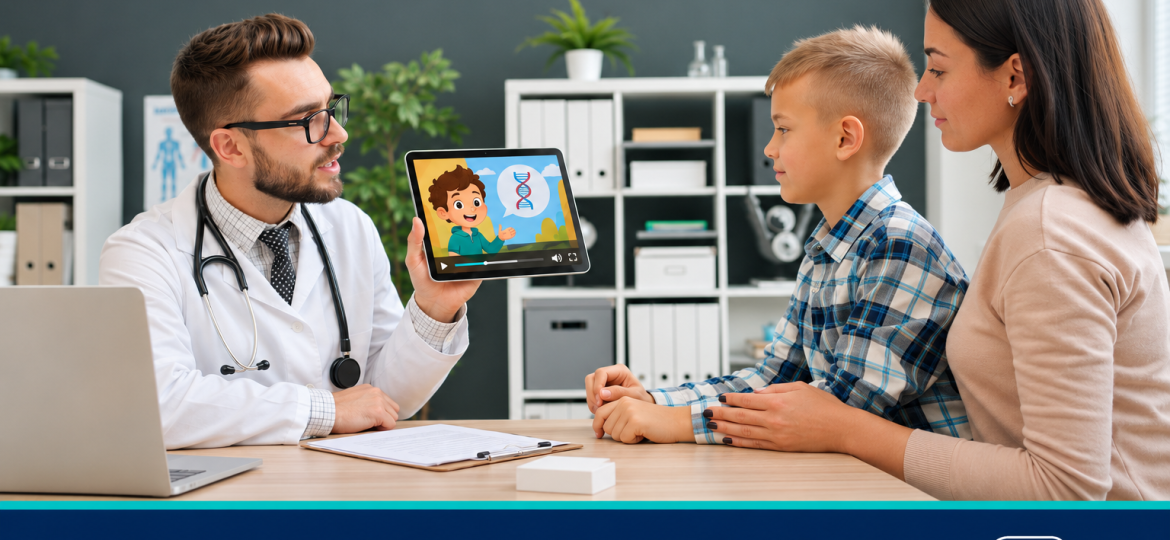
A rare disease biopharma needed its patient education in new languages: first an animated video, then patient kits, brochures, and a children’s book. The video explains a rare childhood condition to families, and the company’s physicians kept asking for the same thing: help explaining it to patients in their own language.
That sounds like a simple request. It wasn’t.
The project
The client is a US-headquartered, commercial-stage biopharmaceutical company with around 400 employees and affiliates in Canada and Europe. Its Canadian team needed the video in Arabic (Egypt) and Inuktitut. Later, the European team came back with the same need for Spanish (Spain) and English for international markets, plus printed patient kits, brochures, and a children’s book.
Nobody in-house could take on the language work, and it was outside the scope of the creative agency that built the video in After Effects. On top of that, the project came with real constraints:
- An existing After Effects project built by the client’s agency
- Very few professional voice actors working in Inuktitut, an Indigenous language
- Approval codes and legal lines specific to each market
- An internal review before any voice could be recorded
Tools can speed up part of this work. They can’t choose a voice a child will trust, and they can’t deliver files that pass a pharma company’s approval process. The client needed one partner to own all of it.
We started with the audience, not the languages
Our first question was: who’s going to watch this video?
The answer was patients, caregivers, and a lot of young children. Every decision after that followed from it. We cast a warm female voice to match the original and the people on the other side of the screen. For Inuktitut, where professional voice talent is scarce, we sourced it, and we delivered both language versions.
We laid out the options and recommended one
For Arabic, we presented three voice-over setups and recommended a professional studio recording, because it gives a more natural result. The client went with it.
Later, for Spanish, we compared human and AI voice-over side by side. We recommended the human voice. The viewers are children, and that settled it.
We fixed the words before recording the voice
The first request covered voice-over only. But the script and on-screen text hadn’t been adapted yet, and if you record narration first, a child ends up hearing one thing and reading another. We flagged it, adapted the script and on-screen text, and only then recorded.
We brought the agency into the process
We asked for the full After Effects working files, audited them, and resolved missing assets with the agency before production started. Then we integrated the new audio into the video ourselves. The client received a finished file, not a folder of audio tracks and a list of next steps.
We built for the next language too
The international team wanted a storyboard it could reuse for every future market. We designed a Word template with scene numbers, screenshots, on-screen action, on-screen text, and the full voice-over script. It drops straight into the company’s approval workflow.
Print, end to end
The patient kits, brochures and children’s book went through a language technology workflow with automated QA, a final linguistic review and desktop publishing back into InDesign. One source file had its text embedded as an image. We rebuilt it instead of shipping a page with two languages on it.
Working on the client’s clock
Our project leads in Spain, Argentina and Peru cover 4:00 to 20:00 (GMT-3), Monday to Friday. That window overlaps the working day of the client’s teams in both Canada and Europe.
What the client got out of it
One handoff, finished files. Language adaptation, voice-over, video integration, and quality checks arrived as a single deliverable, so the team had far fewer production steps to coordinate.
Confident choices for a young audience. The client compared production options side by side and picked the one that fit children and their families. Narration and on-screen text stayed consistent, so a child hears the same message they read.
An easier path to new markets. The European team now works from a reusable storyboard template that fits its approval workflow. Every new language version starts from the same approval-ready structure.
Why this matters
In healthcare, success isn’t market share. It’s getting the right information to the right people on time. A family that hears a condition explained by a voice that sounds like it cares has a better chance of following along, and of bringing the right questions to the next appointment.
Does your team need patient materials that work across languages and approval systems? Talk to us at hi@stillmanst.com.
- Photo by Vitaly Gariev on Unsplash