
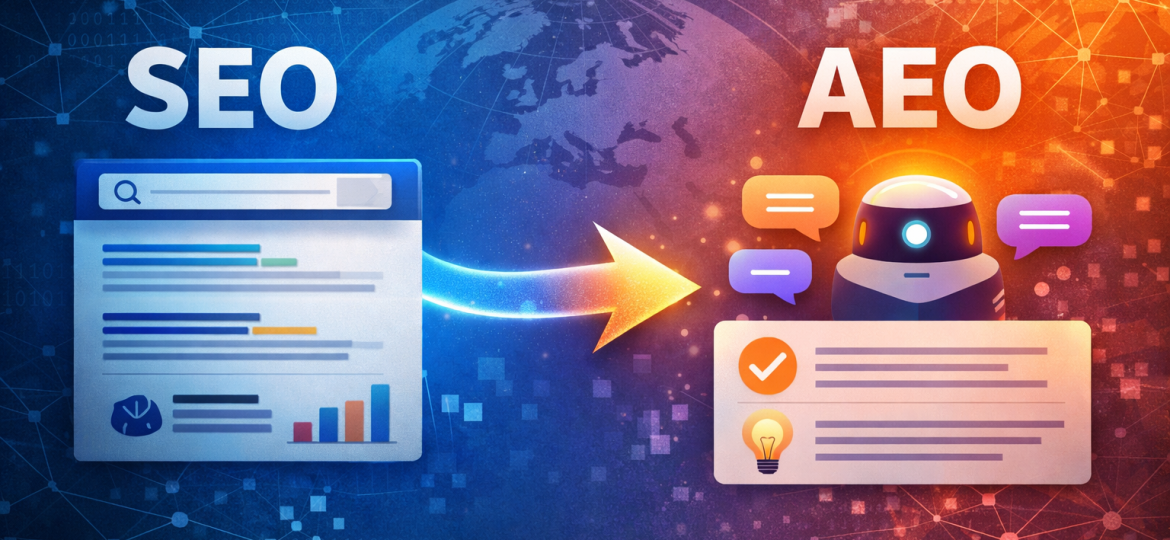
Until recently, digital visibility meant one thing: being found. Today, it means something else entirely: being used as a source of truth.
For more than two decades, Search Engine Optimization (SEO) defined how companies approached digital visibility. The goal was simple: when someone searched for a relevant keyword, your website should appear among the top results. If your page ranked well, users clicked. Traffic followed visibility.
Today, that model is evolving.
Users increasingly interact with technology in a different way. Instead of browsing through a list of links, they ask questions and expect immediate answers. Search engines, AI assistants, and conversational platforms are adapting to this behavior by providing direct responses generated from multiple sources.
This shift is where Answer Engine Optimization (AEO) becomes relevant.
From search results to direct answers
Traditional search worked through a clear process: a user typed a query, the search engine displayed a list of results, and the user selected a page to read. Visibility depended on ranking within that list.
Now, the experience is changing. AI-driven interfaces increasingly summarize information directly on the results page or within conversational systems. Instead of ten links, users may receive a single structured explanation.
In this environment, visibility is no longer determined only by ranking. It depends on whether a company’s content can serve as a reliable source for the answers being generated.
AEO focuses on making that possible.
What AEO means in practice
Answer Engine Optimization is not simply an extension of SEO. It demands a shift in how organizations structure and communicate their expertise online.
Content, language, and domain expertise can no longer function in silos — they need to work as a coordinated system. This is where structured multilingual workflows become essential, especially for organizations operating in regulated or highly specialized environments.
While traditional SEO relied heavily on keywords and backlinks, AEO prioritizes elements such as:
- clear explanations of complex topics
- structured content that directly answers specific questions
- authoritative expertise within a defined field
- natural language that mirrors how people ask questions
The objective is no longer just to attract clicks. It is to ensure that your knowledge can be understood, extracted, and synthesized by systems that generate answers.
Expertise becomes the new signal
In an answer-driven environment, clarity and authority become key signals of visibility.
Organizations that demonstrate consistent expertise in their field are more likely to be recognized as trustworthy sources of information. This is particularly relevant for companies operating in specialized sectors such as legal services, regulatory environments, technology, or healthcare.
When professionals search for complex information, they are not simply looking for a website. They are looking for a reliable explanation.
Companies that structure their knowledge clearly and consistently are better positioned to provide that.
The multilingual challenge
For global organizations, language introduces an additional layer of complexity.
Questions about products, regulations, and services are asked in multiple languages across different markets. If the explanation of a concept changes from one language to another, digital authority becomes fragmented.
Maintaining conceptual consistency across languages is therefore essential. Accurate terminology, cultural nuance, and domain expertise all play a role in ensuring that the same knowledge is communicated clearly in every market.
This is where structured multilingual strategies become critical.
Stillman Solutions Team helps organizations manage this complexity by combining tech-enabled workflows with expert human review. This approach allows companies to maintain precision in specialized content while ensuring consistency across languages and regions.
Building visibility in an answer-driven world
The shift from SEO to AEO is not a technical adjustment — it is a structural one.
Organizations must rethink how they create, organize, and communicate knowledge if they want to remain visible in an answer-driven world.
Because in this new landscape, visibility is not about being present.
It is about being precise enough, consistent enough, and trustworthy enough to become part of the answer.
And that requires more than content.
It requires a system behind it.
The evolution from SEO to AEO reflects a broader change in how information is discovered online. Visibility is no longer only about appearing in search results. It is about contributing knowledge that systems can use to generate answers.
Organizations that adapt to this shift will focus on structuring expertise, answering real questions, and maintaining clarity across languages. In a digital ecosystem increasingly shaped by intelligent systems, the companies that succeed will be those whose knowledge is trusted enough to become part of the answers themselves.